Of all the decisions involved in choosing pet insurance, when should you get it? Timing has the biggest impact on how useful your policy will be. You can’t fix poor timing later, even if you choose a great plan.
Why Enrolling Young Matters
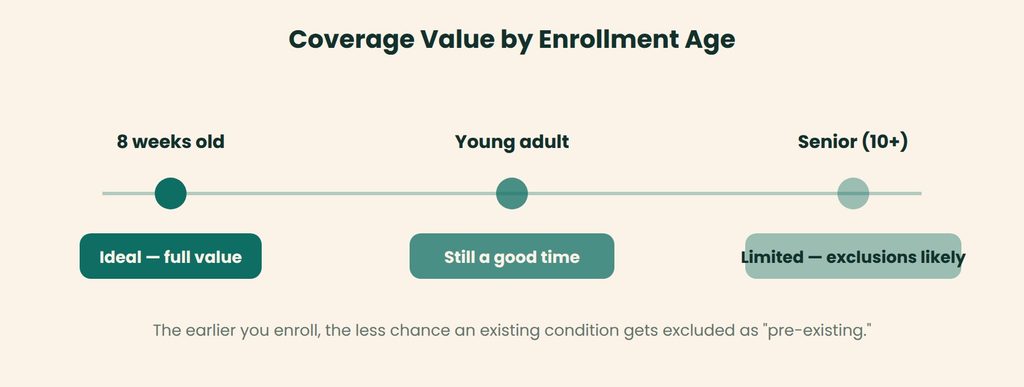
Every pet insurance policy excludes pre-existing conditions — anything your pet showed signs of before coverage started. A puppy or kitten enrolled at 8–10 weeks old has almost no medical history. As a result, insurers have very little to exclude based on past health issues. That single fact is why “enroll early” is close to universal advice from veterinarians and insurance advisors alike.
There’s a second reason too: premiums are generally lowest for young, healthy pets, and they climb steadily with age. Locking in coverage while your pet is young means you’re also locking in a lower starting price before any breed-related risk factors have had the chance to show up.
What Happens If You Wait
Waiting doesn’t make a pet uninsurable, but it does shrink what the policy can actually do for you:
- Any condition that’s developed by the time you enroll — even something minor and fully resolved, like a past ear infection — may be excluded permanently with that insurer
- Premiums are higher for an older pet enrolling for the first time than they would have been at the same age with continuous coverage
- Breed-related conditions that tend to show up with age (arthritis, certain cancers, heart conditions) have a higher chance of already being present, or close to it, by the time you apply
None of this means waiting is a disqualifying mistake — it just means the coverage will realistically do less than if you’d started earlier.
Enrolling a Senior Pet: Is It Too Late?
Not entirely, but it comes with real limits. Some insurers cap the age for new enrollments (Trupanion, for example, publishes enrollment age limits on its site), others do not, so check the limit before you apply. Premiums for a senior pet enrolling fresh are also much higher than for a younger animal: MoneyGeek’s examples run from about $22 a month for a young Chihuahua to $243 for a senior French Bulldog. Coverage for a senior pet still protects against new, unrelated conditions going forward — it just won’t help with anything that’s already present or already being managed.
For owners of an older pet who’s been healthy so far, enrolling now is still often worth it for whatever comes next, even knowing existing issues won’t be covered.
The Ideal Enrollment Window
If there’s a genuinely optimal window, it’s this: as soon as you bring a puppy or kitten home, once they’re old enough to qualify (Healthy Paws, for instance, lists a minimum enrollment age of 8 weeks), before their first illness or injury of any kind. For an adult pet you’ve just adopted with an unknown history, the next-best time is simply now — every month of delay is a month where something new could show up and become excluded.
A Worked Example: Enrolling at 8 Weeks vs. After a Diagnosis
Two owners get the same Dachshund. One enrolls at 8 weeks. The other waits, and at age 4 the dog is diagnosed with a slipped disc (BestMoney range for spinal surgery: $2,500 to $8,000). Assume a $500 deductible and 80% reimbursement, and a $6,000 bill.
| Enrolled at 8 weeks | Enrolled after the diagnosis | |
|---|---|---|
| Slipped disc surgery, $6,000 | Covered: ($6,000 − $500) × 80% = $4,400 paid | Excluded as pre-existing: $0 paid |
| Your cost | $1,600 | $6,000 |
| Premiums paid over 4 years (illustrative, at $40 a month) | $1,920 | $0 so far |
The early policy costs about $1,920 over four years and pays $4,400 on one claim. The late policy would cost nothing before the diagnosis, but it also pays nothing for it. This is illustrative, not a prediction: most pets do not have a spinal problem. The point is that insurance only covers what happens after you enroll. For breeds with known risks, see common health problems by dog breed and Dachshund insurance.
Frequently Asked Questions
Does the waiting period reset if I switch insurance companies? Yes, in most cases — moving to a new provider generally means a new waiting period and a fresh review of what counts as pre-existing, even if you had continuous coverage elsewhere.
Is there a “wrong” age to start, other than very old? No — the only real risk is delay itself, since every month without coverage is a month where a new condition could develop and end up excluded later.
Should I wait until my pet actually gets sick to decide if insurance is worth it? That’s the one approach guaranteed not to work — once a condition exists, it’s already excluded from being covered by a new policy.
The Bottom Line
Pet insurance rewards early decisions more than almost any other type of coverage, because the exclusion that matters most — pre-existing conditions — is entirely about timing. Enrolling a young, healthy pet is the single best way to get full value out of a policy; enrolling later still has value, just with a shorter list of things it can actually help with.
Sources
- BestMoney via MediaFeed, The 17 Most Common Pet Health Issues Will Set You Back This Much.
- MoneyGeek, Average Pet Insurance Cost for Dogs, updated September 17, 2026.
- Healthy Paws and Trupanion official sites, checked October 13, 2026, for minimum and maximum enrollment ages.