
Veterinary medicine has come a long way in the last decade — MRIs, chemotherapy, orthopedic surgery, and specialist referral hospitals are all fairly routine now. The catch is that this kind of care comes with a human-hospital-sized price tag. Care that once meant hard choices is now routine, and it is priced that way: BestMoney’s cost guide puts bloat surgery at $1,500 to $7,500, a slipped disc at $2,500 to $8,000 and a hip replacement at $5,000 to $15,000. Pet insurance exists so that decision comes down to what’s best for your pet, not what’s left in your checking account.
How Pet Insurance Actually Works
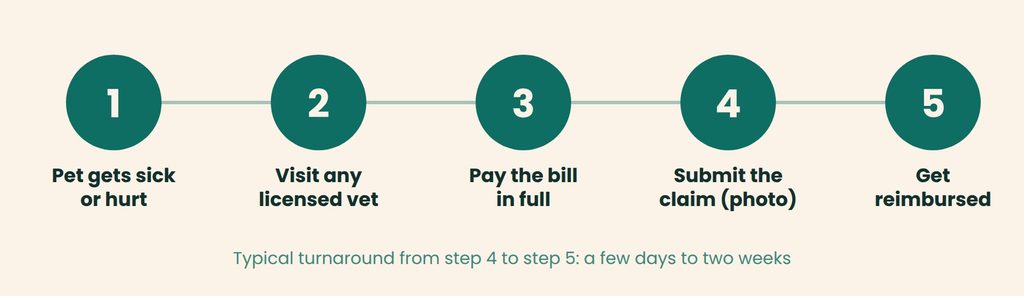
Unlike human health insurance, pet insurance almost always runs on a reimbursement model. The typical flow looks like this:
- Your pet gets sick or hurt.
- You take them to any licensed vet — there’s no network to check first.
- You pay the bill in full, the same as you would with no insurance.
- You submit the itemized receipt to your insurer, usually by photo through an app.
- The insurer reimburses a percentage of the bill, minus your deductible, on a timeline that varies by insurer. Healthy Paws says approved claims are reimbursed on average within 2 business days, and Embrace says 90% of claims are paid in 10 days.
A handful of newer providers now offer direct pay at partnering clinics, where the insurer pays the vet directly and you only cover your share at checkout. It’s convenient, but it’s still the exception rather than the rule — most policies still work on reimbursement.
What a Typical Policy Actually Covers
Most policies sold today are accident & illness plans. That usually includes:
- Injuries: broken bones, swallowed objects, bite wounds, car accidents
- Illnesses: infections, cancer, diabetes, digestive problems
- Hereditary and congenital conditions in many cases — hip dysplasia, certain heart defects
- Diagnostics, surgery, hospitalization, and prescription medication tied to a covered condition
Routine care — vaccines, annual exams, flea and heartworm prevention — is usually not included unless you add a separate wellness plan, which behaves more like a fixed-benefit add-on than true insurance.
The Three Numbers That Set Your Premium
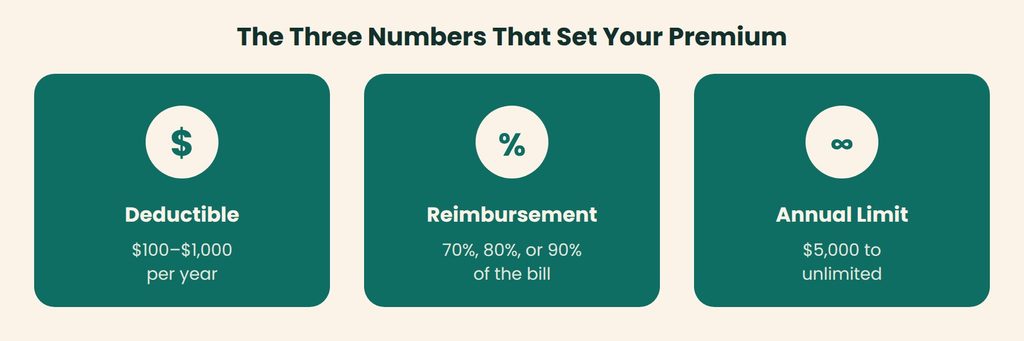
Every policy is built around three choices you make at enrollment, and they interact directly with what you pay each month:
- Deductible — what comes out of your pocket before reimbursement starts, usually somewhere between $100 and $1,000 a year
- Reimbursement rate — the percentage of the bill paid after the deductible, most commonly a choice of 70%, 80%, or 90%
- Annual limit — the maximum the insurer will pay per policy year, from a few thousand dollars up to unlimited on some plans
A lower deductible and a higher reimbursement rate both push your premium up — the same trade-off as car or home insurance.
A Worked Example: One Claim, Step by Step
Suppose a dog needs emergency surgery and the vet bill is $4,000. Your policy has a $500 deductible, 80% reimbursement and a $5,000 annual limit, the same standard settings that MoneyGeek uses to model premiums. This is an illustration, not a real claim.
| Step | Amount |
|---|---|
| Vet bill, paid by you at the clinic | $4,000 |
| Minus the $500 deductible | $3,500 |
| Insurer reimburses 80% | $2,800 |
| Your final cost | $1,200 |
If the bill were $9,000, 80% of the amount above the deductible would be $6,800, but the $5,000 annual limit would stop the payment there and you would pay $4,000. For more on how limits and deductibles change the result, see our guide to payout limits and annual vs. per-incident deductibles.
Enrolling Your Pet
Healthy Paws’ puppy and kitten plans start at 8 weeks old, and some insurers set an upper age limit for new enrollments: Trupanion, for example, says it enrolls pets up to age 14. A policy that is already active on an older pet is normally kept in force at renewal. Age and breed both factor into your premium, since some breeds are statistically more prone to specific conditions.
Is It Really Different From Human Health Insurance?
In a few important ways, yes:
- No provider network. You can go to your regular vet, an emergency hospital, or a board-certified specialist, anywhere in the country.
- You usually pay first, then get reimbursed — the opposite of how most human insurance works at the point of care.
- Pre-existing conditions are excluded, similar to how U.S. health insurance worked before the Affordable Care Act.
Frequently Asked Questions
Does pet insurance cover routine checkups? Only if you add a wellness plan on top. Standard accident & illness coverage is built around unexpected problems, not preventive care.
Can I use any veterinarian? Yes — since there’s no network, your regular vet, an emergency clinic, and a specialist all qualify equally.
How long does reimbursement actually take? Most companies process a claim within a few days to two weeks of receiving the paperwork, though this varies by provider and how complete your submission is.
The Bottom Line
Pet insurance isn’t a savings account — it’s protection against the one vet bill you can’t predict or budget for. Understanding the reimbursement model, what a standard policy actually covers, and the three levers that set your premium is the foundation for comparing any two plans on equal terms.
Sources
- BestMoney via MediaFeed, The 17 Most Common Pet Health Issues Will Set You Back This Much.
- MoneyGeek, Average Pet Insurance Cost for Dogs, updated September 17, 2026.
- Healthy Paws, healthypawspetinsurance.com, accessed October 13, 2026.
- Embrace Pet Insurance, embracepetinsurance.com, accessed October 13, 2026.
- Trupanion, Pet insurance comparison, accessed October 13, 2026.