
Your pet insurance deductible is one of three numbers that set your premium — and it’s also the one most new pet owners glance past without realizing there are two completely different structures behind it.
Annual Deductibles Explained
An annual deductible works the way most people already expect from car or health insurance: you pick an amount — commonly $100, $250, $500, or $1,000 — and once your total covered vet costs for the year cross that number, every claim afterward gets reimbursed at your chosen percentage.
Example: with a $250 annual deductible and 80% reimbursement, your first $250 of covered costs in a policy year comes out of your pocket. After that, an $800 vet bill gets you $640 back, and so does every claim after it, for the rest of the policy year.
This is the far more common structure in the industry today, and it’s generally the better deal for a pet with more than one health event in a year.
Per-Incident Deductibles Explained
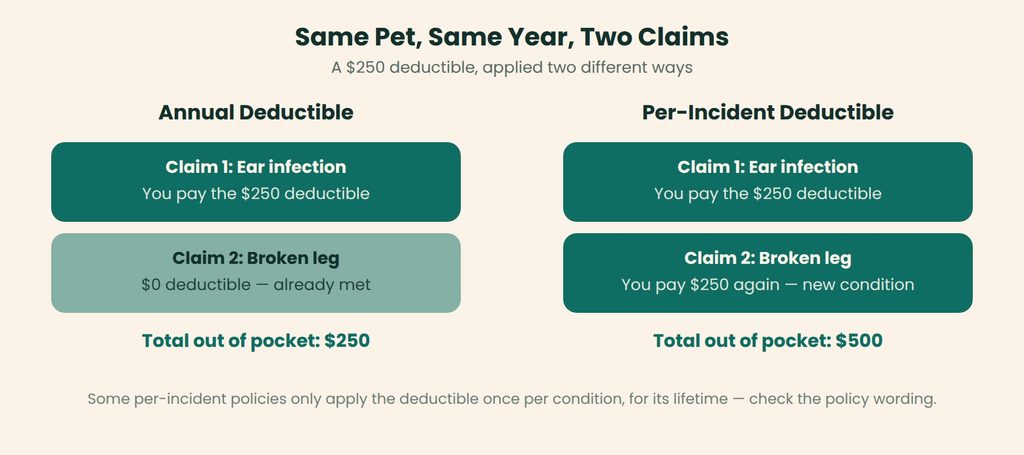
A per-incident (or per-condition) deductible resets for every new condition, rather than for the policy year as a whole. If your dog is treated for an ear infection and later, separately, swallows a toy, you’d pay the deductible twice — once for each unrelated condition.
Some per-incident policies apply the deductible only once per condition for its lifetime (so a chronic illness like diabetes only triggers the deductible the first time, then it’s covered going forward), while others apply it every single time that condition is treated. This distinction matters enormously for a pet with an ongoing condition, so it’s worth confirming exactly which version a policy uses before enrolling.
Which Structure Actually Saves You More
For most pets, an annual deductible works out cheaper over a full policy year, simply because it only has to be met once no matter how many separate issues come up. A per-incident deductible can look attractive on paper with a lower headline number, but it adds up fast for a pet that ends up with two or three unrelated issues in the same year — which is common enough that it’s worth planning around.
Per-incident deductibles tend to make more sense only in the narrower case of a pet with a single, well-defined chronic condition and a policy that applies the deductible just once for that condition’s lifetime.
How Your Deductible Choice Affects Your Premium
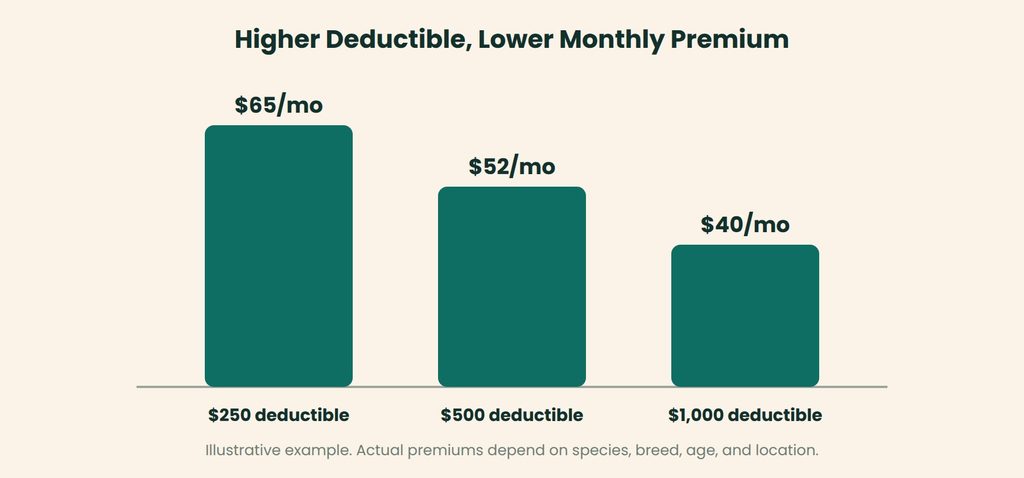
The relationship is straightforward and works the same way it does with any insurance product: a lower deductible means the insurer is taking on more of the early cost, so the monthly premium goes up. A higher deductible lowers your premium but means more comes out of your pocket before reimbursement kicks in.
How much a higher deductible saves depends on the provider, species, age and the reimbursement rate you select alongside it, and we have not found a reliable average to quote. Price the same pet at two deductibles with the same insurer and compare, as the next example shows.
A Worked Example: Same Year, Two Structures
Say a dog has three unrelated problems in one year: an ear infection ($400), a swallowed sock ($2,000) and a skin allergy flare ($600). Reimbursement is 80% in both cases. These bills sit within BestMoney’s typical ranges for each condition.
| Event | Bill | $500 annual deductible: insurer pays | $250 per-incident deductible: insurer pays |
|---|---|---|---|
| Ear infection | $400 | $0 (deductible used: $400) | ($400 − $250) × 80% = $120 |
| Swallowed sock | $2,000 | ($2,000 − $100 left) × 80% = $1,520 | ($2,000 − $250) × 80% = $1,400 |
| Skin allergy | $600 | $600 × 80% = $480 | ($600 − $250) × 80% = $280 |
| Total paid by insurer | $3,000 | $2,000 | $1,800 |
Even though the per-incident deductible is half the size, it pays $200 less here because it applies three times. With only one claim in the year, the per-incident plan would have come out ahead, which is why the right choice depends on how many separate problems your pet is likely to have. For the full picture of what you pay, see how pet insurance works.
Picking the Right Deductible for Your Budget
- If cash flow is tight but you have some savings cushion: a higher deductible with a lower monthly premium usually makes sense — you’re betting on paying more only in the years something actually happens.
- If you’d struggle to cover even a few hundred dollars unexpectedly: a lower deductible, even at a higher monthly cost, removes that risk entirely.
- If you are somewhere in between: a mid-range deductible such as $250 to $500 often balances the monthly price against what you pay per claim.
Frequently Asked Questions
Can I change my deductible after enrolling? Most insurers allow this at renewal, though changing it can sometimes affect how existing conditions are treated — it’s worth asking directly rather than assuming.
Is a $0 deductible ever available? A small number of providers offer very low or no-deductible options, almost always at a significantly higher premium.
Does the deductible apply to wellness add-ons too? Usually not — wellness plans typically pay out as a fixed benefit per item (like $50 toward an annual exam) rather than working through the accident & illness deductible at all.
The Bottom Line
Annual deductibles are simpler, more predictable, and usually the better value for a typical pet’s lifetime of care. Per-incident deductibles can look cheaper on the surface but often cost more in practice the moment more than one unrelated issue comes up in the same year — read the specific policy language before assuming which one you’re actually being offered.
Sources
- MoneyGeek, Average Pet Insurance Cost for Dogs, updated September 17, 2026 (standard $500 deductible, 80% reimbursement).
- BestMoney via MediaFeed, The 17 Most Common Pet Health Issues Will Set You Back This Much (cost ranges for ear infections, allergies and foreign objects).