Whether pet insurance is worth it is not a yes-or-no question. It depends on what the premiums cost, how large a vet bill you could face, and whether you could pay that bill from savings. This guide sets real premium figures against real treatment costs so you can judge for your own pet.
The Real Math: Premiums vs. Potential Vet Bills
MoneyGeek’s August and September 2026 reports put the average premium for a standard accident & illness policy ($5,000 annual limit, $500 deductible, 80% reimbursement) at about $32 a month for cats and $61 for dogs, or roughly $386 and $732 a year. Individual quotes range widely: from about $22 a month for a young Chihuahua to $243 for a senior French Bulldog. Compare that to what a single serious incident can cost without insurance, according to BestMoney’s cost guide:
- Slipped disc or spinal surgery: $2,500–$8,000
- Foreign object removal (swallowed toy, sock, etc.): $800–$5,000
- Hip replacement: $5,000–$15,000
- Bloat surgery (GDV): $1,500–$7,500
A single event like these costs several years of premiums. On the standard settings above, a $6,000 bill leaves you paying $1,600 and the insurer $4,400, while the same bill paid from a savings fund that has only been building for two years ($1,464 at $61 a month) leaves you more than $4,500 short. Whether you are likely to face one depends on your pet’s breed, age and luck, which is exactly what you cannot know in advance.
When Pet Insurance Tends to Pay Off
- Emergency surgery or trauma — genuinely unpredictable, genuinely expensive
- Cancer — treatment can run for months and is hard to self-fund. It is a known risk in some breeds, such as Golden Retrievers and Boxers
- Chronic illness diagnosed young — diabetes or a thyroid condition diagnosed at age 3 means years of ongoing costs that insurance absorbs
- Breeds with known genetic risk — the odds of a large bill are higher for breeds prone to hip dysplasia, certain cancers, or heart conditions. See common health problems by dog breed

When It Might Not Be Worth It
Being honest about the other side of this matters just as much:
- A healthy, low-risk mixed breed with no history of major issues in the family line may go years without a claim that comes close to what you’ve paid in premiums
- An owner with a solid emergency fund already set aside specifically for the pet may come out ahead self-insuring, especially if they never end up needing it
- Very old pets enrolling for the first time often face high premiums and long exclusion lists for pre-existing conditions, which shrinks the practical value
The Alternative: Self-Insuring With a Pet Savings Fund
Some owners choose to set aside the equivalent of a monthly premium — say $40 a month — into a dedicated savings account instead of paying an insurer. The upside is that unused money stays yours. The downside is real: if a major expense hits in year one, before the fund has built up, you’re exposed in a way an insurance policy wouldn’t leave you.
A Simple Framework to Decide
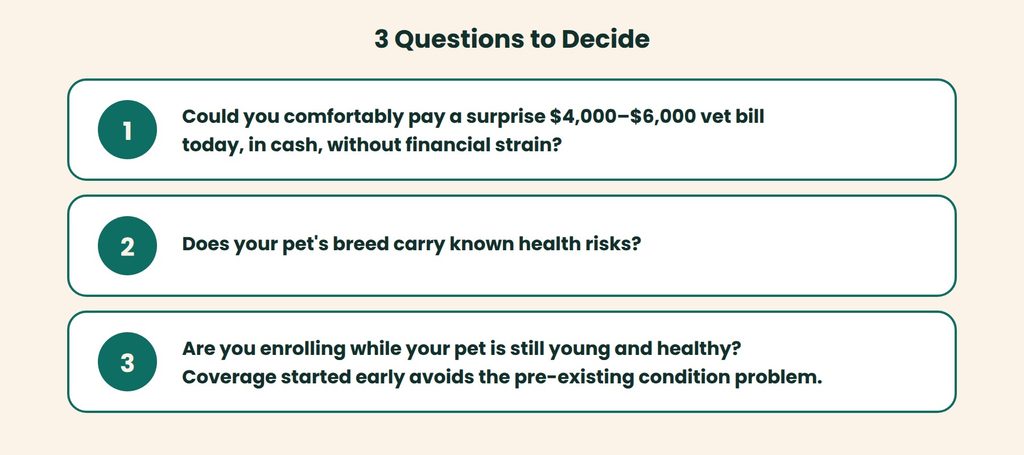
Ask three questions:
- Could you comfortably pay a surprise $4,000–$6,000 vet bill today, in cash, without financial strain? If not, insurance (or a fully-funded pet savings account) matters more than the premium cost.
- Does your pet’s breed carry known health risks? If yes, the odds shift meaningfully in favor of coverage.
- Are you enrolling while your pet is young and healthy? Coverage started early avoids the pre-existing condition problem that makes insurance far less useful later in life.
Frequently Asked Questions
Is pet insurance a waste of money if my pet never gets sick? Only in hindsight. The value of insurance is protection against the outcome you can’t predict in advance — the same logic applies to any insurance product.
Does pet insurance ever pay for itself? For plenty of owners, yes, especially with even one major claim. For others with genuinely low-risk pets, premiums may end up exceeding claims over a lifetime — which is also how insurance is supposed to work for the pool as a whole.
What’s the single biggest factor in whether it’s worth it? Enrolling early, before any condition exists that could be excluded as pre-existing.
The Bottom Line
Pet insurance isn’t universally “worth it” or “not worth it” — it depends on your risk tolerance, your pet’s breed and age, and whether you already have a real financial cushion set aside specifically for vet emergencies. What tips the scale for most owners is simple: a genuinely unaffordable vet bill is more common than people expect, and insurance is the tool built specifically to absorb it.
For the full comparison with saving the money yourself, see pet insurance vs. a savings account, and for a single indoor cat, the break-even calculation.
Sources
- MoneyGeek, Average Pet Insurance Cost for Dogs, updated September 17, 2026.
- MoneyGeek, Average Pet Insurance Cost for Cats, updated August 26, 2026.
- BestMoney via MediaFeed, The 17 Most Common Pet Health Issues Will Set You Back This Much.
