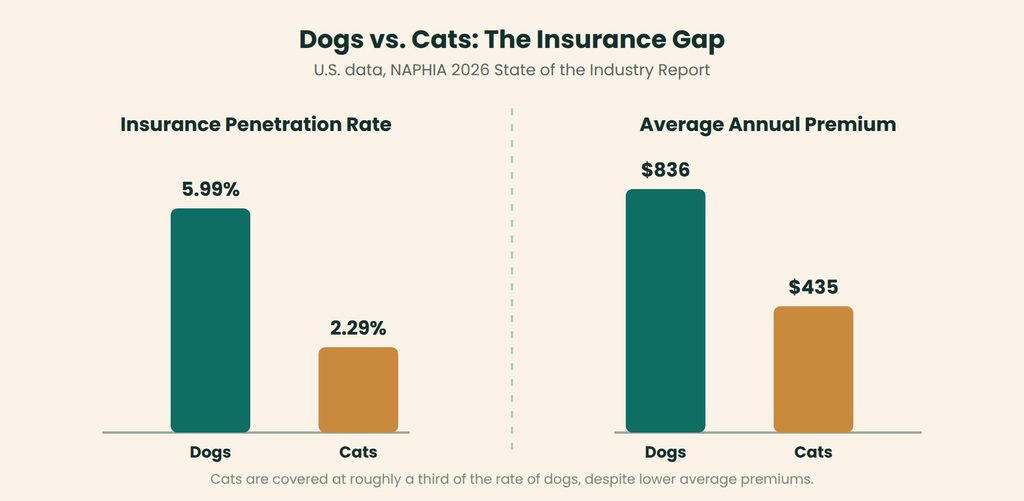
Cats are as common in U.S. homes as dogs, yet industry reports consistently show that cats make up a much smaller share of insured pets (see NAPHIA’s industry data, which counts 7.6 million insured pets in North America at the end of 2025). Finding the best pet insurance for cats starts with understanding why that gap exists, and why closing it matters more than most owners assume.
Why Cat Owners Insure Their Pets Less Often Than Dog Owners
Part of the reason comes down to perception: people see cats as low-maintenance pets, and they often consider indoor cats lower-risk than dogs, which owners regularly take on walks and in cars. Part of it is genuine differences in claims patterns — cats have fewer dramatic accidents than dogs, so the “protect against an emergency” pitch lands less obviously. Premiums reflect this too: MoneyGeek’s 2026 reports put a standard policy ($5,000 limit, $500 deductible, 80% reimbursement) at about $32 a month for cats versus $61 for dogs. But cats develop plenty of expensive, chronic conditions as they age, and those conditions are exactly where a policy earns its keep.
What the Best Pet Insurance for Cats Should Cover
- Chronic illness with no lifetime cap — kidney disease, diabetes, and hyperthyroidism are all long-term conditions common in cats, especially as they age
- Urinary tract coverage — feline lower urinary tract disease and urinary blockages are common enough in cats (especially males) to matter for nearly every owner
- Dental illness, not just dental injury — periodontal disease is close to universal in older cats
- Cancer coverage with a reasonable annual limit, since certain cancers (lymphoma in particular) are among the more common serious diagnoses in cats
Breed matters here too — Maine Coons and Persian cats each carry well-documented risks worth knowing before you compare policies.
How Cat Policies Differ From Dog Policies
The mechanics are the same — reimbursement model, deductible, reimbursement percentage, annual limit — but pricing usually runs lower for cats than for similarly-covered dogs, largely because average claim sizes tend to be smaller. That doesn’t mean the value is lower; insurers can price policies according to a cat’s actual risk profile, making them one of the better values in the pet insurance market.
Indoor vs. Outdoor Cats
An indoor-only cat faces less accident risk (no cars, no fights with other animals) but the same or greater illness risk as it ages. An outdoor or indoor-outdoor cat adds real accident exposure — cars, other animals, parasites, and infectious disease — on top of that. Both profiles benefit from coverage; they just benefit from it in different ways, which is worth keeping in mind when comparing accident-only and accident & illness plans.
A Worked Example: A Cat’s Year With and Without Cover
At the MoneyGeek cat average of $32 a month, the policy costs about $384 a year. BestMoney’s cost guide gives typical ranges for conditions that commonly affect cats: a urinary tract infection around $600, diabetes $1,500 to $2,500 a year, and dental disease $400 to $10,000. With a $500 deductible and 80% reimbursement:
| Event | Bill | Insurer pays | You pay |
|---|---|---|---|
| Urinary tract infection | $600 | $80 | $520 |
| Diabetes, one year of care | $2,000 | $1,200 | $800 |
| Dental disease needing extractions | $1,500 | $800 | $700 |
A small bill like a UTI barely clears the deductible, so a plan does little for minor events. The value is in the larger ones, and especially in chronic disease that repeats each year. For the break-even maths on an indoor cat, see this worked calculation; for older cats, senior cat insurance.
Frequently Asked Questions
Is pet insurance worth it for a cat that mostly stays healthy? Chronic conditions like kidney disease affect a large share of cats as they age regardless of how healthy they seem earlier in life, which is part of why coverage still tends to pay off over a cat’s full lifetime.
Does breed affect a cat’s insurance cost the way it does for dogs? Yes, though less dramatically — insurers consider documented breed-specific risks, such as heart disease in Maine Coons and kidney disease in Persians, when they set their prices, just as they do with dog breeds.
Should I get accident-only or accident & illness coverage for a cat? Accident & illness coverage is generally the better fit for cats because chronic illnesses account for a significant share of their lifetime health risks, rather than accidents alone.
The Bottom Line
The best pet insurance for cats treats chronic illness as the main event, not an afterthought. Cats may look low-risk next to dogs, but kidney disease, dental disease, and cancer often drive their lifetime vet costs — and accident & illness coverage is designed to cover these conditions.
Sources
- MoneyGeek, Average Pet Insurance Cost for Cats, updated August 26, 2026.
- MoneyGeek, Average Pet Insurance Cost for Dogs, updated September 17, 2026.
- BestMoney via MediaFeed, The 17 Most Common Pet Health Issues Will Set You Back This Much.
- NAPHIA, industry data, 2026.